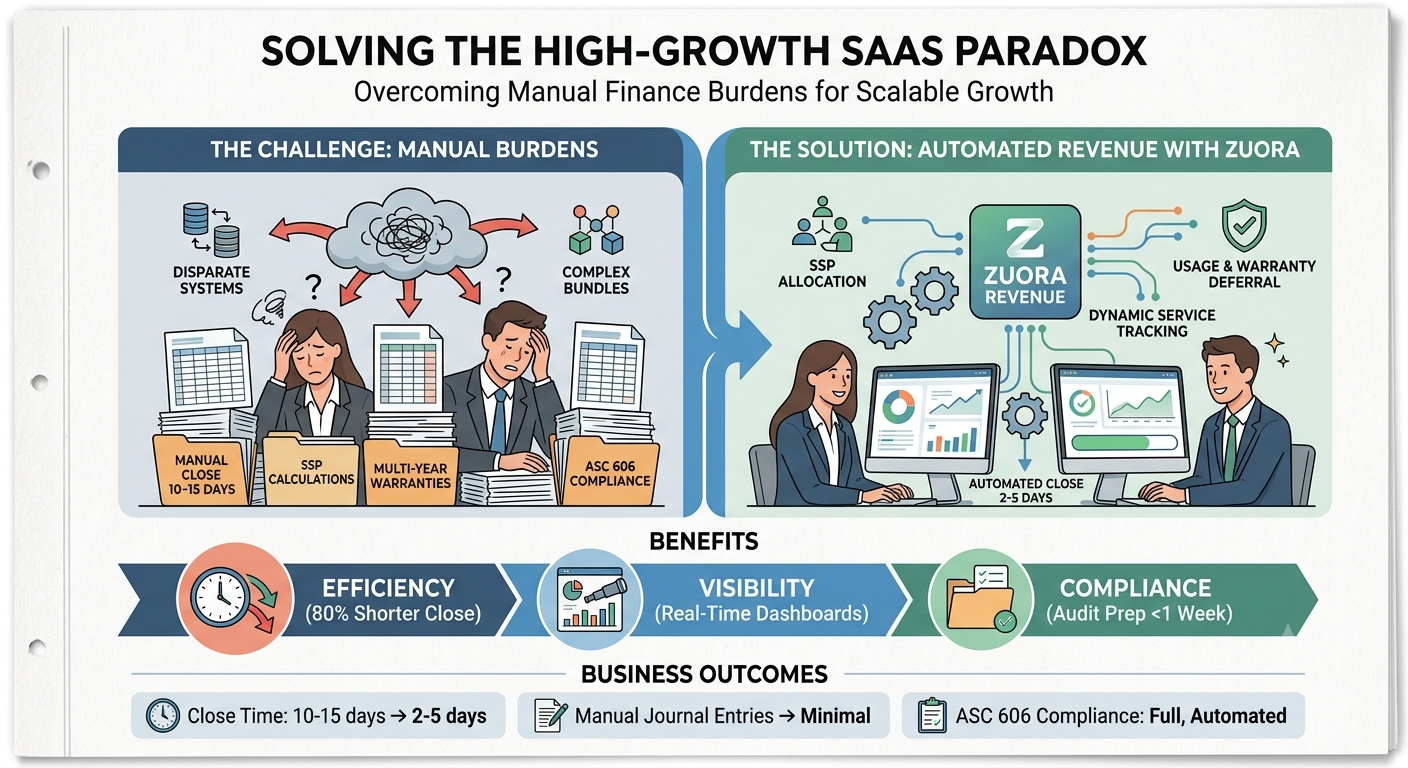

In the fast-moving software-as-a-service (SaaS) industry, success can sometimes bring hidden challenges. We call this the High-Growth Paradox: as a company grows and its subscription packages expand, the finance department can quickly become overwhelmed by manual work. While sales teams celebrate massive growth, the finance and operations teams often end up buried in spreadsheets, trying to navigate intricate accounting rules like ASC 606.
To break through this barrier, modern SaaS leaders are moving away from manual workarounds and adopting automated systems to manage their complex finances smoothly at scale.
The Challenge: The High-Growth SaaS Paradox
Success in the SaaS industry often brings a hidden operational burden. While the sales team celebrates explosive growth and diverse new subscription models, the finance and revenue operations teams are frequently left buried under spreadsheets.
The company faced several critical back-office obstacles:
- Slow Close Cycles: Because data was stored in multiple disparate legacy systems, it took 10-15 days each month just to close the books.
- Complex Bundles and Calculations: Determining the Standalone Selling Price (SSP) for services like bundled customer support was highly dependent on other products and required exhaustive manual calculations.
- Intricate Billing Scenarios: Handling multi-year warranties, usage-based professional services, and net-billed reseller transactions posed compliance and data-tracking risks under ASC 606.
The Solution: Automating Revenue with Zuora Revenue
To bridge the gap between front-office sales and back-office accounting, the team deployed Zuora Revenue with a structured five-stage implementation approach: Discovery, Design, Integration, Validation, and Rollout.
The platform automated complex revenue recognition policies using advanced rules and smart Data Augmentation:
- Automated SSP Allocation: The system is built with a multi-step logic to automatically calculate and assign the correct Standalone Selling Price for bundled support lines without manual intervention.
- Dynamic Service Tracking: Configured date-logic rules to automatically fix incorrect service start and end dates based on original source data.
- Usage & Multi-Year Warranties: Transformed multi-year warranty charges into “Usage” products with “On Demand” invoicing, ensuring revenue is cleanly deferred and recognized ratably over the full duration of the service.
- Reseller Transaction Compliance: Implemented a custom billing amendment process that automatically adjusted sales data to properly reflect gross revenue and separate reseller discounts as operating expenses.