
12 Sep 7 Reasons Mid-Market Manufacturers Need More Than an ERP Upgrade
7 Reasons Mid-Market Manufacturers Need More Than an ERP Upgrade
Upgrading your core ERP in isolation often leaves key production and supply chain problems unaddressed. While traditional software updates and patches may resolve surface-level issues, they rarely tackle the deeper operational inefficiencies that limit growth. For mid-market manufacturers looking to scale, a true solution goes beyond a standalone ERP upgrade. Operational excellence depends on integrated systems, advanced analytics, and a commitment to continuous process improvement.
Here are 7 Reasons to Adopt an ERP System
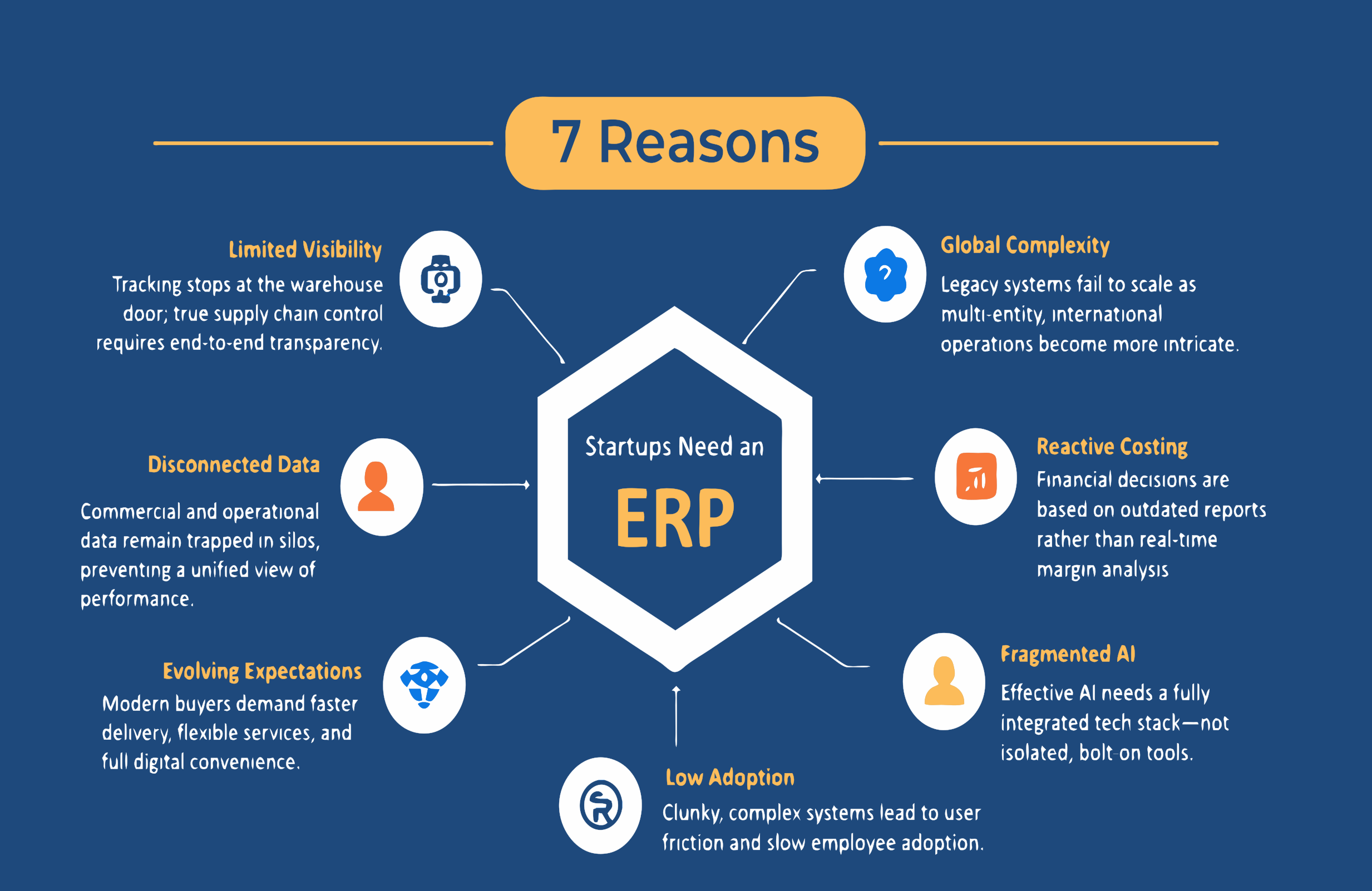
Reason 1: Disconnected Commercial and Operational Data.
When sales and operations work in silos, delivery commitments are made without real-time visibility into factory capacity. This disconnect leads to inaccurate quotes, missed production schedules, and ongoing friction between teams.
The Fix: By integrating CRM and CPQ tools with real-time shop-floor data, commercial teams gain direct access to live inventory, asset history, and active orders. This enables them to make accurate commitments to customers and bridge the gap between sales and operations.
Reason 2: The Need for True End-to-End Visibility (Beyond the Four Walls)
While a typical ERP manages internal production and inventory, modern manufacturers need visibility beyond the factory floor. Access to customer service histories, distributor relationships, and field service assets is now essential. A unified view connects production with post-sale engagement and ongoing support.
The Fix: An ERP upgrade extends tracking beyond the warehouse, linking manufacturing with post-sale support and asset history. This gives teams a single view of the entire product lifecycle, from production through to field maintenance.
Reason 3: Outgrown Multi-Entity and Global Complexities
As manufacturers expand across locations, subsidiaries, or currencies, legacy systems and basic upgrades quickly fall short. Organizations need cloud platforms that support scaling, adding new entities, and meeting global compliance requirements without major system changes.
The Fix: An ERP upgrade enables organizations to scale, add new entities, and meet compliance requirements without revamping infrastructure. New subsidiaries or plants can be brought online within the same ERP platform, ensuring core operations remain uninterrupted.
Reason 4: Moving from Reactive Costing to Real-Time Financial Control
Manual data entry or batch updates commonly expose cost overruns and material waste only after production is finished. Protecting profit margins requires real-time connections between labor, machine usage, material tracking, and financial reporting.
The Fix: Integrating labor, machine data, and material usage with live financial dashboards enables active margin management. Real-time monitoring helps protect profit margins at every stage of the production cycle.
Reason 5: Evolving Buyer Expectations and Service Demands
Today’s manufacturing buyers and distributors expect fast responses, self-service options, and instant order updates. Simply upgrading software does not improve customer experience unless service and order management are fully integrated with production data.
The Fix: Integrate order management and field service with production data during your ERP upgrade to deliver automated, live updates to clients. When customers can instantly check order progress and service status, customer contentment and loyalty naturally increase.
Reason 6: Artificial Intelligence Requires a Connected Stack, Not a Bolt-On
Many assume that adding artificial intelligence features to any legacy database will quickly transform operations. In reality, AI delivers value such as demand forecasting, automated warranty claims, and predictive maintenance only when it receives clean, integrated data from both operational and commercial systems.
The Fix: Supplying AI models with unified data from ERP, CRM, and IoT systems allows accurate demand forecasting, automated warranty claims, and predictive maintenance. Clean, cross-functional data turns basic algorithms into valuable operational tools.
Reason 7: The Human Element and Behavioral Adoption
Most modernization initiatives fail not because of the software, but because teams continue with old habits. Attaining lasting improvement requires structured change management and training that shifts daily employee behavior, not just the introduction of new tools.
The Fix: Software alone is not enough. Sustainable digital transformation combines platform automation with structured change management and role-based training to build user assurance. When employees understand the reasons behind new workflows, adoption follows.
A modernized ERP is essential, but true competitive advantage comes from connecting operations, commercial insight, and practical AI within a unified strategy. During an ERP upgrade, manufacturing leaders should evaluate their entire technology ecosystem—including ERP, CRM, data analytics, and shop-floor automation—to build long-term resilience.