

Netsuite SuiteBilling
Introduction to Subscription:
The world is moving away from traditional accounting practices for revenue recognition to globally acknowledged International Financial Reporting Standards (IFRS). This involves moving away from traditional “services” setup to Subscription-based services. The likes of NetFlix and Amazon have paved the way for subscription-based billing for the rest of the world to follow.
What is a Subscription Business Model?
The subscription business model is a business model in which a customer must pay a recurring price at regular intervals for access to a product. We can say that subscriptions are contractual agreements, even if there is not a formal, signed contract. If a customer subscribes to your service and agrees to a “Terms of Service” (also known as “Terms of Use” or “Terms and Conditions”), then they have engaged in a contract with your company.
Challenges for Hybrid business models with billing requirements:
Software companies continue to confront the evolution of billing models. As businesses continue to adapt the way they sell software, we expect to see the ongoing transition from perpetual license plus maintenance to subscription models. Even pure subscription providers are examining usage-based approaches that align with customer usage. Billing software systems must now have real-time visibility into core business transactions, a requirement that standalone billing systems simply cannot handle. To effectively adapt to this new reality, business management software systems must have a billing component as part of the core infrastructure. Across the board, software companies face the challenge of managing billing across hybrid business models.
Why SuiteBilling?
With the move to a subscription economy, businesses need a way to generate invoices that accurately reflect pricing and consumption over a defined period. Available only to NetSuite users, NetSuite SuiteBilling helps companies streamline billing operations, providing real-time visibility into billing and financial activity. From consolidated invoicing, automated rating processes, and support of multiple pricing models, SuiteBilling provides transparency around all billing activities. Additionally, we can say that SuiteBilling was tailored for Subscription-based billing where usage fluctuates (metered billing). The ability to add and remove products to a subscription is equally useful.
- Flexible Pricing Plans:
NetSuite allows standard and customer-specific price plans based on volume, tiered and flat pricing.
Flat Pricing: Charge customers the same value each billing cycle.
Volume Based Pricing: Based on consumption or entitlement where the highest volume tier unit rate reached is applied to the entire quantity to charge.
Tiered Pricing: In this method, the rate for each unit of consumption or entitlement tier is applied to a specific range. The total end rated value is comprised of varying per unit rates to achieve the final amount to charge. - Streamlining Billing Process:
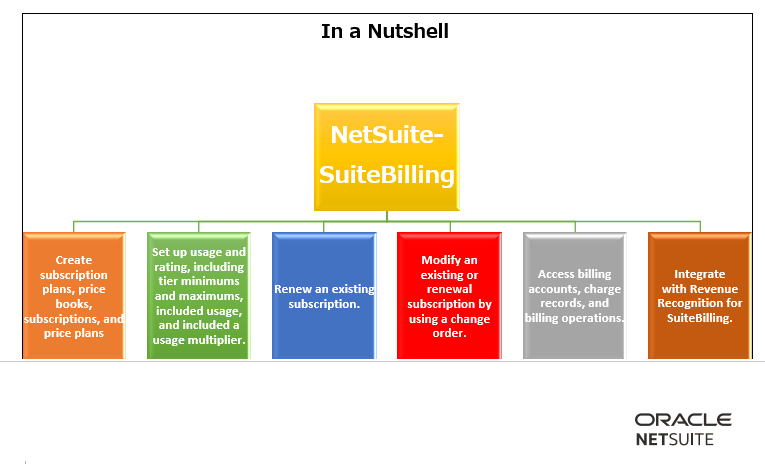
With NetSuite SuiteBilling, an entity can attain complete automation of its billing process. SuiteBilling supports subscription models from evergreen to traditional time-based (e.g. 1-year, 3-year). Changes to subscriptions such as upsell, downsell, suspend, and terminate are easily managed. Revenue Leakage is reduced with automated renewals. SuiteBilling can help you with automated renewals process reducing the hassle of needing to revisit each and every contract for renewal. - Managing subscription Lifecycle:
You can manage subscription lifecycles of all your services with a few clicks! Right from the creation of Subscription items, creation of orders, change orders to dynamic revenue and billing reports, you can do it all with SuiteBilling.
Change Orders SuiteBilling allows organizations to schedule and automate changes to subscriptions. Change orders provide the ability to schedule an immediate or future-dated change to pricing and/or quantities on subscriptions. Eliminate the need to manually monitor and track customer subscription changes. With SuiteBilling, these changes can be recorded at the time they are identified and will be active upon reaching the effective date set on the change order
Customer-Specific Pricing and Discounting SuiteBilling provide the ability to create both common pricing templates and customized scenarios to support customer-specific deal negotiations and contracts. Generic subscriptions can be created and used for all customers or a specific subset. Customized subscriptions built off alterations to existing subscriptions, or net-new, enable users to create specific pricing and contract agreements for customers, including specific discounting rules per item in the subscription. - Powerful rating engine to automate as usage/ consumption billing:
Flexible options give businesses the choice of billing subscriptions as either one-time charges or recurring fees, either in-advance or in-arrears. With multiple rating models, companies can create subscriptions that capture setup fees, license counts, and variable consumption all in one step. The combination of easy subscription set up and maintenance and flexible rating models significantly increase billing process efficiency. - Seamlessly consolidate charges from multiple subscriptions:
Reporting Real-time reporting provides quick and easy insight into common billing and financial data, including monthly recurring revenue, total contract value, and customer churn.
Pros of Using SuiteBilling:
- Subscription billing with changing usage.
- Consolidated invoicing.
- Additional reporting specific to the software industry.
- SuiteBilling can be integrated with other Softwares like SalesForce.
How We Help:
- RevGurus specializes in the implementation of NetSuite ERP, SuiteBilling, SuiteSuccess, SRP, and managed services through a team of certified Chartered Accountants and certified professionals.
- RevGurus have experienced Functional and SuiteCloud consultants who provide end to end solutions for complex business scenarios, who want to implement ERP and leverage NetSuite solutions. RevGurus is also authorized by NetSuite to implement Multi-book and Advanced Revenue Management solutions too.
- RevGurus adopts the best practices in Revenue Management Services through robust Project Management and NetSuite Methodology with a strong focus on providing cost-effective, timely, and quality deliverables.
Frequently Asked Questions (FAQs)
Can SuiteBilling manage both one-time fees and recurring charges on the same invoice?
Yes, it is built to handle complex billing requirements, including one-time, recurring, and usage-based charges in a single, consolidated bill.
How does RevGurus help with SuiteBilling implementation?
Our certified consultants specialize in aligning SuiteBilling with your core ERP, providing tailored automation and expert support that ensures a seamless transition from sales order to revenue recognition—something only RevGurus delivers.
Does SuiteBilling support automated renewals?
Yes, it automates the entire renewal process, reducing manual administrative work and ensuring no revenue is lost during contract transitions.
How does it help with compliance like ASC 606?
SuiteBilling integrates seamlessly with NetSuite’s revenue management modules to ensure all subscription billing follows the latest compliance standards.
Frequently Asked Questions (FAQs)
Can SuiteBilling manage both one-time fees and recurring charges on the same invoice?
Yes, it is built to handle complex billing requirements, including one-time, recurring, and usage-based charges in a single, consolidated bill.
How does RevGurus help with SuiteBilling implementation?
Our certified consultants specialize in aligning SuiteBilling with your core ERP, providing tailored automation and expert support that ensures a seamless transition from sales order to revenue recognition—something only RevGurus delivers.
Does SuiteBilling support automated renewals?
Yes, it automates the entire renewal process, reducing manual administrative work and ensuring no revenue is lost during contract transitions.
How does it help with compliance like ASC 606?
SuiteBilling integrates seamlessly with NetSuite’s revenue management modules to ensure all subscription billing follows the latest compliance standards.