

NetSuite Multi-Book

Need for Multi-book:


The NetSuite multi-book accounting feature provides the ability to maintain multiple sets of financial records in parallel to support various accounting and reporting standards.


Due to complex organization structures and complex legal and regulatory compliance, many finance professionals are potentially left having to spend countless hours using Excel spreadsheets to adjust NetSuite Reporting to conform to a secondary Accounting Standard, including Tax Adjustments, IFRS reporting, ASC 606 Retrospective Reporting, or Industry-specific reporting.


Available only to NetSuite users, it allows multiple financial records to be created from a single set of financial transactions. Leveraging NetSuite Multi-Book’s feature of “Book Specific” Journal entries, the finance department is able to readily run financial statements based on industry, country, state, or currency requirements out of the same environment with just a simple selection of a different accounting book.
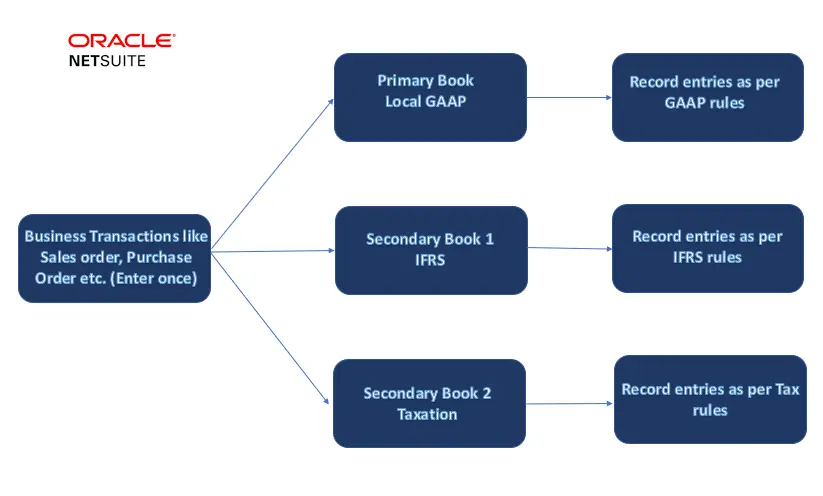
netsuite-multibook-accounting

Key Benefits:


    1. Optimize financial close process:
      Real-time posting of data to all books avoids waiting until period-end to replicate data, thereby reducing manual intervention and effort.
    2. Real-time visibility of reports:
      Reporting has never been so dynamic previously. NetSuite’s robust reporting features, along with Multi-Book’s real-time data posting, generate accurate flash report financials for any book, any time.
    3. Effective Financial Management: NetSuite Multi-Book enables effective financial management across the enterprise, with subsidiary-book relationship mapping capabilities that accurately perform financial reporting and analysis.

With NetSuite Multi-Book, an organization can:


  1. Use different functional currencies in certain subsidiaries.
  2. Use different accounting principles for certain subsidiaries.
  3. Update its revenue recognition rules due to an update in revenue recognition accounting standard and wants to keep two sets of accounting book (one with old standard and one with new standard).
  4. Allows consolidation in both the Primary Book and any Secondary Book.
  5. Depreciate fixed assets differently across different books.
  6. Post accounting transactions to different account in different books.
  7. International company that have a complex definition of local statutory COA.

Reach out to the Experts:


  • RevGurus specializes in implementation of NetSuite ERP, Advance Revenue Management and Multi-Book implementations leveraging their functional experts who are mainly Certified Accountants with ERP experience.
  • RevGurus have experienced Functional and SuiteCloud consultants who provide end to end solutions for complex business scenarios, who want to implement ERP solutions on cloud. RevGurus team is authorized by NetSuite to implement Multi-book and Advanced Revenue Management. As an experienced and certified pool of ERP consultants and technical team, we are capable of implementing large ERP projects.
  • RevGurus adopts the best practices in NetSuite implementations that is backed by robust Project Management, focusing on timely and quality deliverables.